
Art doesn’t start in a hand.
It starts upstream—in the part of you that notices, chooses, aims, and edits.
Your hand isn’t the author. Your mind is. Your spirit, your soul.
That’s why two people can touch the same piano and make two different worlds. Meaning comes first. Execution follows.
I’m disabled. I’ve created professionally for over 30 years—writing, design, music.
Recently, I’ve been told—more than once—that if I use AI, I’m not making “real art.” I’ve even heard that from able-bodied people who claim to advocate for the disabled.
What they’re really saying is simple: if you can’t do it the old way, you don’t get to do it at all.
But that’s not how authorship works.
My consciousness didn’t become less human because my body became less reliable. I didn’t stop bearing the image of the Creator because my hands hurt.
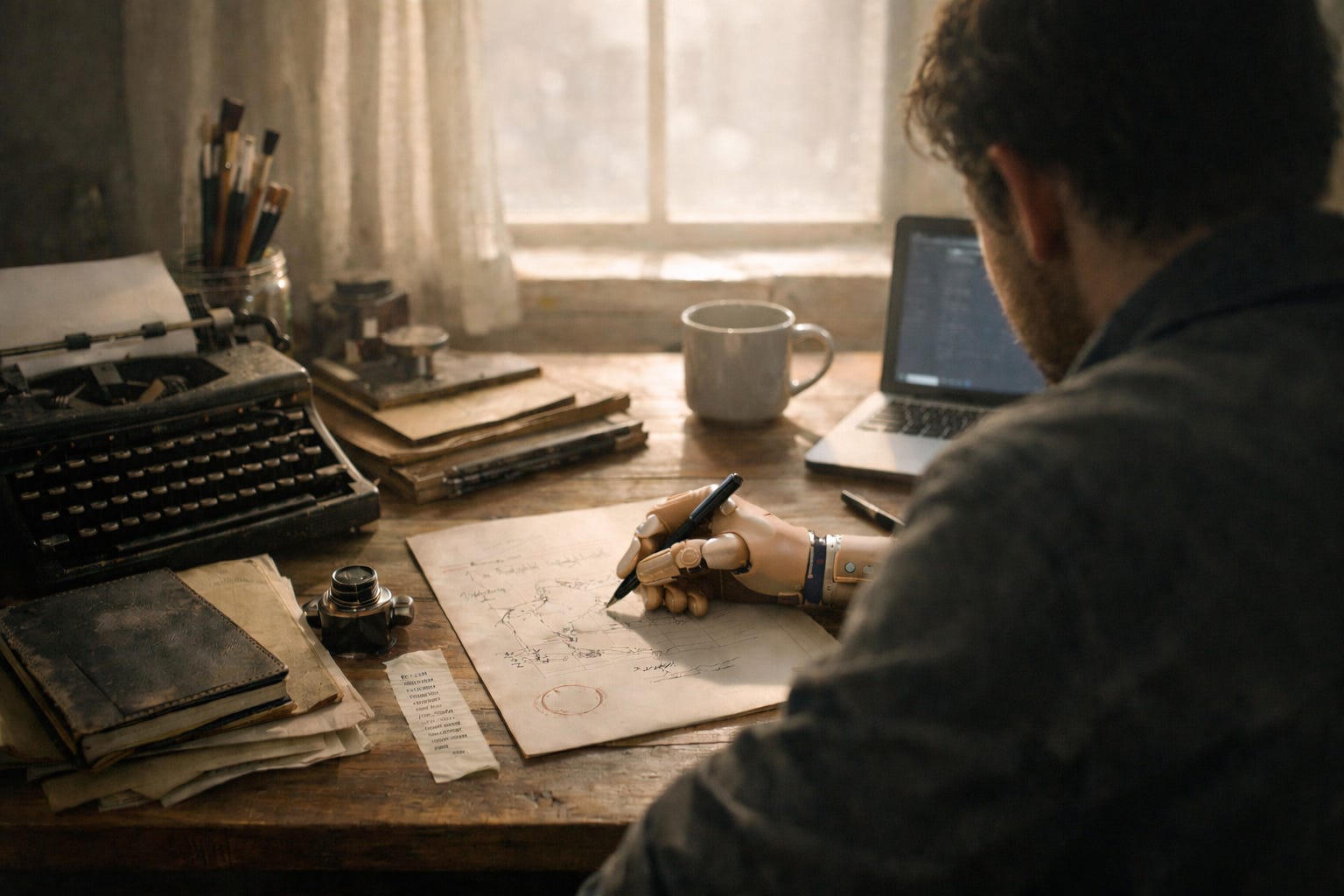
For me, AI is an artificial limb.
Not a shortcut. Not a cheat. An artificial limb.
A prosthetic doesn’t erase a runner’s will to move. A hearing aid doesn’t erase a musician’s ear. Assistive tech doesn’t replace the person—it restores access.
And access is not immoral.
People keep asking, “Where’s the line?”
So here’s the standard:
Don’t lie.
Don’t clone people’s likeness without consent.
Don’t use AI as a counterfeiting machine.
We already live with tools that reduce effort and expand ability. Spell check. Cameras. Digital editing. Noise reduction. Auto-save. The modern creative stack is full of “assistance.”
Sadly, we only start calling assistance “evil” when it helps the “wrong” people.
When it helps the disabled.
When it helps the outsider.
When it helps the cash-strapped creator without a big budget, a big network, and a lot of spare time.
Here’s the part the many fail to realize: new tools rarely kill the old way—what they actually do is reprice it. When something becomes easier to produce at scale, the fully human version almost always becomes more valuable because it becomes rarer. Photography didn’t end painting; it pushed painting further into “handmade, intentional, premium.” Same with vinyl, film, letterpress, live performance, hand-built anything. So if you love the old way, breathe. It won’t vanish. It will specialize. And that’s good: access expands without erasing craft.
And yes—AI slop is real.
But so is human slop. We’ve always had lazy songs, rushed books, bad logos, cheap knockoffs. AI didn’t invent mediocrity. It just makes mediocrity faster.
Which is exactly why craft matters more, not less. Learning matters. Taste matters. Respect for the work matters. AI can’t substitute for that. It only amplifies what you’re willing to bring to the table.
A lot of creators aren’t blocked by imagination.
They’re blocked by constraints: gear, collaborators, time to learn, and any support that makes the work visible. Creative work has always had an entry cost. If someone starts with less runway, that person hits more gates.
AI lowers many of those gates.
Not by magically granting taste. Not by “making someone an artist.”
But by shortening the distance between “I have the idea” and “I shipped it”—drafts, variations, packaging, formatting, promo basics, translation/subtitles for wider reach.
That’s not “less art.”
That’s more people being able to make—and more people being able to earn from what they make.
Now the objection everyone throws like a brick:
“Isn’t AI stealing?”
Humans learn by exposure. A painter studies paintings. A songwriter absorbs chord moves. A novelist steals nothing by reading—he learns patterns, then makes choices.
AI learns the same way: it studies patterns in lots of examples, then generates from what it learned. It isn’t a hidden bookshelf designed to spit your exact work back out on command.
The real issue isn’t learning.
The real issue is conduct.
If someone uses AI to impersonate a real person, rip off a living artist on purpose, or pass off machine output as hand-made, that’s wrong—period. That’s a human problem, not a tool problem.
Used with integrity, AI isn’t theft.
It’s access.
And for some people—disabled creators, creators with limited resources, creators who’ve been priced out of the room—access isn’t a luxury.
It’s the difference between the lie, “Some lives have less value than others,” and the timeless truth, “Everyone is created equal.”
We are all creative beings made in the image of a Supreme Creative Being.
Nothing can change that.