

what we were made for
In one breath, Genesis tells us what people are and, later, what people are for.
God makes humanity in his image, and in the same sentence he says what the image is for. So the question “what were we made to do?” has an answer, and the answer is not a list of separate duties. It is one calling in four parts: a goal, a form, a mode, and a assignment. Most of us—myself included—live life backwards.
the assignment
Genesis 1:26–28 says God made people in his image and likeness.
Then come the actions: rule, subdue, be fruitful, multiply, fill the earth. That is royal language. In the ancient world, a king would set up statues of himself across his territory, and the statue carried a message: the king’s rule reaches here. Sometimes the king himself was called the living image of his god, ruling the land on the god’s behalf. Genesis takes that royal idea and expands it. Every man and every woman carries the image and shares the rule.
Rule and subdue are strong words, and people have used them as permission to strip the earth. But the sentence itself sets the limit. We rule as an image, and an image has to act like the one it represents. A steward who governs against his king’s character has stopped serving the king and started stealing the throne.
So the job is to spread the kind of order that takes care of what it rules.
the mode
Genesis 2:15 makes the job more specific.
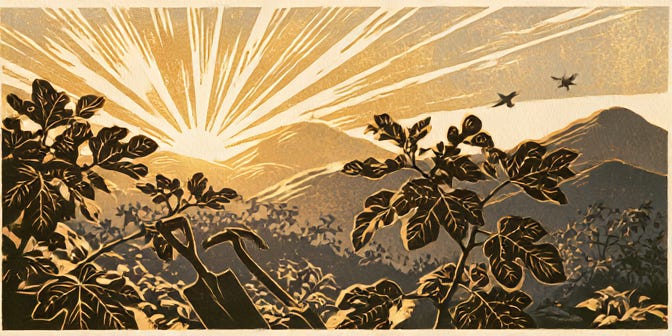
God puts the man in the garden “to work it and keep it.” Those two verbs sound ordinary. But they show up together again in Numbers 3 and 18, where they describe what priests do in God’s tabernacle: they serve it and guard it. Eden has other temple features too. God walks there. A river flows out of it. A tree stands at the center, and when Adam and Eve are sent out, angel guards are posted at the door. The garden is a sanctuary. So the calling is priestly as well as royal: carry God’s presence, guard the holy place, and push the borders of Eden outward until the garden and the world are the same size.
One Hebrew word settles what kind of work this is. The word is avad. It means “to work,” and it also means “to worship.” The same word covers both. When God tells Moses at the burning bush that Israel will “serve” him on the mountain, that is avad too. We treat work and worship as two different things. Hebrew treats them as one thing. Work offered to God is worship, and the split we feel between Monday and Sunday came in with the fall, not with the design.
Naming the animals adds one more layer. God brings the animals to Adam and waits to see what he will call them. Out of that come language, categories, culture.
The image-bearer is a maker too, and the work is truly his.
the form
When someone asked Jesus to name the greatest commandment, he gave two.
Love God with everything you have. Love your neighbor as yourself. Everything else in the Law and the Prophets hangs on those (Matthew 22:37–40). Paul goes further. Prophecy will end, he says. Tongues will stop. Knowledge will pass away. Love remains (1 Corinthians 13:8–13). Whatever survives into the new creation has a strong claim to being what creation was for in the first place.
So love is not a second job sitting next to ruling. Love is what ruling looks like when it is done right. God is love (1 John 4:8), so an image of God will show love the way a mirror shows a face. Augustine said we become what we love.
The order of our loves becomes the order of our lives.
the goal
There’s a detail in Genesis 3:8 that is easy to miss.
God is walking in the garden in the cool of the day, and the wording is casual. It sounds like a habit, a walk that had happened many evenings before this one. Whatever else Eden was, it was a place where God and people kept company as a normal thing.
The rest of the Bible treats that as the destination. Jesus defines eternal life as knowing the Father (John 17:3). The Bible’s last pages show God moving in with his people for good (Revelation 21:3). The scholar Michael Heiser adds a family angle: when God says “let us make man,” he is speaking to his heavenly household, and he is making an earthly family to match it. If that is right, the job flows out of the relationship, never the other way around. We are not employees. We are family, and family gets things to do.
Worship lives at this same level. Genesis 1–2 has no altar and no sacrifice, and some readers conclude that worship came later, after sin. Better to say a temple does not schedule worship. Inside a temple, everything done rightly is worship. Later texts say it outright. God formed Israel for his glory and to declare his praise (Isaiah 43:7, 21). The songs around the throne say every created thing exists for him (Revelation 4:11).
That raises an old objection. A God who makes creatures to praise him sounds needy. C.S. Lewis gave the best answer: praise is how enjoyment completes itself.
Joy that never finds words has not finished being joy.

why this order?
Admittedly, it is easy to create an order and harder to prove it.
So test it.
Here is the first test. Each level can be faked without the level above it, and none can be produced without the level above it. Anyone can rule without worshiping; history is largely the record of it. People can worship without love, and the prophets attacked that very thing: sacrifices from hearts far away (Isaiah 1:11–17; Amos 5:21–24). People can love without God for a while, running on moral effort, and much of the modern West runs on it still: love with the power source unplugged. But it never runs the other direction. A living relationship produces love. Love takes the form of worship. Worship gets its hands dirty as work. Life flows down the levels, and fakes climb up them. That difference is what makes this a true order.
The second test takes on the obvious rival. Why is being with God the goal, and why not God’s glory? Isaiah says God created us for his glory, and the old catechism says our chief end is to glorify God and enjoy him forever. Jonathan Edwards answered this long ago. God’s glory and our joy are not two goals fighting for first place but one goal seen from two sides, because we glorify God by knowing and enjoying him. Glory is the goal from God’s side. Communion, being with him, is the same goal from ours. And saying it from our side avoids a bad implication: God never needed an audience.
Why is love the shape and not the goal? Because love points beyond itself, toward the one loved. God did not need to create in order to love. The Father loved the Son before the world existed (John 17:24).
Inside God, love is already communion, and that settles which comes first.
what the fall wrecked
Genesis 3 cuts the top level first.
The exile is exile from presence, and angels guard the road back. Then everything below fails in sequence. Paul retells the same collapse in Romans 1:21–25 without quoting Genesis at all. They knew God but would not honor him or thank him: communion refused. Their hearts grew dark, and love bent out of shape. They traded God’s glory for statues and pictures, worship aimed at the wrong address. And God handed them over to conduct that degrades, rule gone bad. Four levels, same order, falling apart instead of standing up. A blueprint that predicts its own crash pattern is telling you something true.
Yet the fall did not erase the design. After the flood, God still forbids murder because people still bear his image (Genesis 9:6). The job is even re-issued to Noah in almost the same words: be fruitful, multiply, fill the earth, rule the animals (Genesis 9:1–7), though now fear sits between us and the animals, and bloodshed needs laws. Psalm 8 still marvels that God crowned human beings with glory and honor and put things under their feet, long after Eden. The office still stands. The officeholder is the problem.
That mix explains life as we know it. Worship survived the fall by changing its address. That is why the Bible worries about idolatry far more than atheism, and why John Calvin called the human heart a nonstop factory of idols. Love curled inward. Work grew thorns. In every case the equipment still runs; the steering is what broke.
So the Bible’s cure, almost everywhere, is redirection.
the one who did
A story that ends without resolution fails to inspire.
So the question is whether anyone ever completely fulfilled their purpose.
The New Testament answers by pointing the whole job at one person, and it uses the same royal psalm the Old Testament used. Hebrews 2:6–9 quotes Psalm 8, humanity crowned with glory and everything under our feet, and then admits the obvious. We do not see that. The world does not obey us and never has. The writer does not soften the psalm or explain it away. He shifts.
We see Jesus—crowned with glory and honor, because he suffered death.
The job humanity failed is not canceled. It is handed to the one who finished it. Paul shows the same move with the same psalm (1 Corinthians 15:27; Ephesians 1:22).
Run the four levels through Jesus and he fulfills them all. His communion never breaks: he does nothing on his own, only what he sees the Father doing, and he is never left alone (John 5:19; 8:29). The one moment that bond tears is the cry from the cross, and he bears it though he had done nothing to deserve it. His love goes the distance, to the very end (John 13:1). His worship takes the shape avad predicts. He took the form of a servant (Philippians 2:7), and remember, in Hebrew, servant-work and worship are one word. His obedience was his offering (Hebrews 10:5–7). And his rule arrives last and complete: after the resurrection he says all authority in heaven and on earth is his (Matthew 28:18), authority held by the one who stooped lowest to get it. That is what the image was always supposed to look like on a throne.
The settings tell the same story. The first Adam was tested in a garden with everything available, and he failed. Jesus was tested in a desert with nothing, and he stood (Matthew 4). Then, the night before the cross, he walks back into a garden, and there he says the sentence that reverses Eden: not my will, but yours.
Of course, a four-part outline can be laid over anyone’s life if you push hard enough, so hold the outline as an illustration. The real argument is Hebrews 2, and it is the Bible’s move:
Quote the job description, admit the failure, answer with Christ.
when work takes over
Back to work.
To the common assumption that work is the main thing we exist for.
The text pushes back. First, work comes before the fall and is called good. What the curse adds is not labor but thorns, sweat, and futility (Genesis 3:17–19). Anxious work, work that has to prove your worth, work that is never enough: that is a good thing under judgment, and the difference matters. You can repent of overwork without abandoning your craft.
Second, look at the calendar. God finishes creating on day six. People are made on day six. So the first full day any human ever lived was the seventh, the day of rest. Hold that loosely, because the text does not give the hour Adam was made, and the math depends on how you count the days. But the idea holds either way. Rest was given and trust felt before any work was done, and creation’s high point comes on the seventh day, the only day with no “evening and morning,” God at rest in his finished temple with his people beside him.
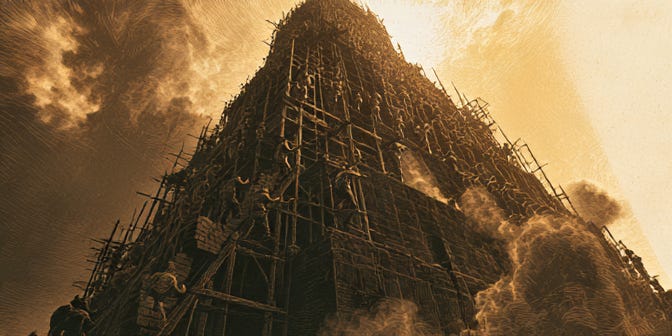
The tower of Babel shows the reversal in action. “Let us make a name for ourselves,” the builders say (Genesis 11:4), echoing God’s own “let us make” from Genesis 1. Told to fill the earth, they huddle in one place because, they say, they are afraid of being scattered. They get scattered anyway. Two chapters later, God gives Abram a great name he never asked for. Nothing in the story says the builders worked too hard.
The problem is the direction: work aimed at making our own name, cut off from the worship it was made to be.
pulling it together
Here’s the whole design in one line: being with God is the goal, love is the shape, worship is the way, and ruling is the job.
Each level depends on the one above it and works through the one below it.
In Christ, the old titles come back. The church is called a royal priesthood (1 Peter 2:9), a kingdom of priests (Revelation 5:10), people who will reign with him (Revelation 22:5), being renewed “after the image of its creator” (Colossians 3:10). That is the original design, restored. Even the Great Commission carries an echo of Eden’s job (go, make disciples, all nations, to the ends of the earth), though how much weight that echo bears is debated, as we will see.
Collapse any level into its neighbor and you get a familiar sickness. Ruling without worship is Babel. Worship without ruling is a faith with no address in the real world. Love cut off from God runs down into sentiment or burns out into duty. And chasing God while ignoring the job becomes a spirituality of escape.
The Bible never recommends that; even Eden had to be worked.
two tough questions
Is the job still ours?
Some serious Reformed teachers, David VanDrunen among them, say no, at least in the way described above. In their reading, the cultural job was Adam’s test. Adam failed it, Christ finished it, and the church has not been handed a world-building program. God’s covenant with Noah, they point out, is made with “every living creature,” and that is not how you address a redeemed people. It is a promise to preserve the world, sealed with a rainbow. Christians work ordinary jobs in the ordinary world; the church’s business is word and sacrament. On this view, turning the gospel into a civilization project claims too much, because the new creation comes by God’s act.
They land two real punches. The Noah covenant really is made with all flesh (Genesis 9:8–17), and the argument above leaned on the earlier verses without saying so. And the Great Commission claim above says more than the text supplies; Matthew 28 is about disciples, and its echo of Genesis 1 is just that, an echo, and echoes do not transfer offices. Both claims have been softened above, and the correction is left visible instead of hidden.
Still, most of this essay survives, because the four levels describe what human beings are as creatures, and even VanDrunen agrees the creation design still stands. The real fight is over a question this essay does not have to settle: how much of what we build carries over into the new creation. Paul says labor in the Lord is not in vain (1 Corinthians 15:58). Revelation shows the glory of the nations carried into the city (21:26). Peter describes the elements dissolving in fire (2 Peter 3:10). Good scholars weigh those texts differently, and the question stays open. The four-level design does not hang on the answer.
Did “rule the earth” wreck the earth?
In 1967 the historian Lynn White wrote a famous short article blaming Christianity’s idea of dominion for the environmental crisis. By stripping nature of its spirits and handing it to man, he argued, the faith gave people a license to exploit. He gets some things right. People really did use Genesis that way; Francis Bacon reached for it while urging science to conquer nature. And White was not out to destroy Christianity. He wanted a greener one, and he nominated Francis of Assisi as the patron saint of ecology.
But his history is weak, because environmental ruin does not follow the map of Christian influence. Ancient Mesopotamians salted their own farmland. Rome stripped North Africa’s forests. Easter Island cut down every tree it had. Large-scale damage arrived with large-scale machines, not with any doctrine. And the Bible he blames is full of restraints an exploiter would have to ignore: rest for the land itself every seventh year (Leviticus 25:1–7), a ban on cutting fruit trees even in wartime (Deuteronomy 20:19), rest for working animals (Exodus 23:12), even sparing the mother bird at a nest (Deuteronomy 22:6).
The deepest answer is the one this essay already gave. Ruling severed from worship is Babel, and what White documents is Babel’s environmental bill. That answer is convenient, and the convenience should be admitted; a framework that swallows its biggest objection as more proof deserves some suspicion. But the answer also costs something. If the damage is what dominion looks like when it is cut off from God, then the damage stands as real evidence against how Christians have practiced their own teaching.
We own that.
smaller debates
A few smaller debates are worth naming.
Scholars differ on what the “image of God” is: our reason and soul, our capacity for relationship, or the royal job itself. Most hold a blend. The priest-language reading of Genesis 2:15 is likely but not certain, because the two Hebrew verbs are common ones. The four labels in this essay are mine, and someone could squeeze the scheme down to three without losing much; I keep four because worship names our God-ward direction in a way that love, which also runs toward neighbor, does not. And Christians have argued for centuries over whether the Sabbath binds all people or was Israel’s covenant sign (Exodus 31:16–17 calls it a sign between God and Israel). None of these debates breaks the shape.
They only change how hard you can lean into certain verses.
what this asks of us
A picture of human purpose that changes nothing is decoration.
This one asks something of us.
First, when life breaks at the bottom, look up the ladder. Work that has gone wrong is rarely fixed by working differently. The trouble usually sits a level or two higher, in worship that has drifted or a relationship with God that has drifted. The symptom shows up at the bottom; the repair starts at the top. That is unglamorous, and you can test it against your own life.
Second, if being with God is the goal, then the measure of a life is not its output. That is easy to say and hard to hold, because output can be counted and communion cannot, and whatever cannot be counted loses to whatever can, unless you guard the order on purpose.
Third, remember which came first. Rest came before the first day of human work. Rest is not the paycheck at the end of the week; it is the ground the week starts from. We reversed that order early, and it stays reversed unless we fight it. Even for believers, a lot of what we call ambition is living life out of order.
May we live our lives with Christ in our sights and our hearts in his hands.
if you wanna’ dig deeper
Timothy Keller, Every Good Endeavor (2012). The best popular book on work as service to God.
C.S. Lewis, Reflections on the Psalms (1958), especially the chapter on praise.
Michael S. Heiser, The Unseen Realm (2015). God’s heavenly family and what “let us make” means.
John H. Walton, The Lost World of Genesis One (2009). Genesis 1 as the opening of a temple.
Abraham Joshua Heschel, The Sabbath (1951). A short, beautiful Jewish book on the seventh day.
Dorothy L. Sayers, “Why Work?” (1942). A short essay, still sharp after eighty years.
John Piper, God’s Passion for His Glory (1998). Reprints Jonathan Edwards’s classic on why God created the world, with a long readable introduction.
academic works:
G.K. Beale, The Temple and the Church’s Mission (2004), on Eden as sanctuary. J. Richard Middleton, The Liberating Image (2005), the royal reading of the image. Gordon Wenham’s Genesis 1–15 commentary (1987). David VanDrunen, Living in God’s Two Kingdoms (2010), the “is the job still ours?” objection in its author’s own words. Albert Wolters, Creation Regained (1985), the answer to it. Lynn White Jr., “The Historical Roots of Our Ecologic Crisis,” Science (1967), five pages, worth reading before anyone’s summary. Richard Bauckham, The Bible and Ecology (2010), the most serious response.