

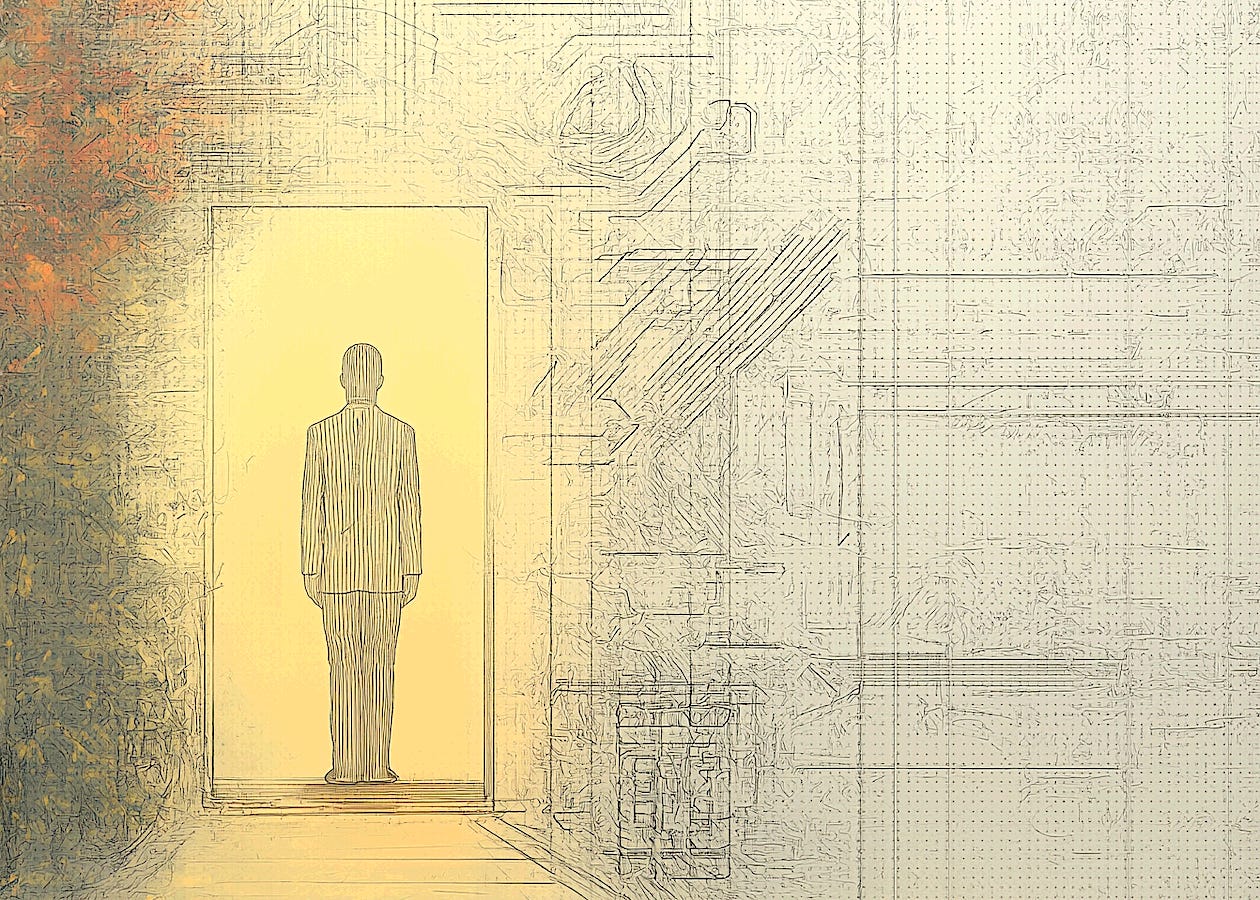
Life doesn’t always crash; sometimes it just shuts off.
Last Friday, my body did exactly that.
One moment I was doing the normal shuffle of tasks and ideas, mentally juggling deadlines and “I should really get to that soon.” The next, it was as if someone had yanked the power cord out of my lower spine.
Sharp, electric pain lit up my low back and hip. Then a different kind of sensation—or non-sensation—spread down my legs and into places you really don’t want going numb: bladder, bowel, both thighs. The ER team started using phrases like “possible saddle anesthesia” and “cauda equina syndrome.” Those are the phrases that come with MRIs, not ibuprofen.
Two days later, I was back home with instructions, meds, and that exhausted relief you get when a worst-case scenario hasn’t fully landed—yet. I eased my way across the bedroom, testing each step like it might crack. And then, without drama or warning, my legs simply weren’t there in the way I needed them to be.
I went down. Hard.
It felt less like being hit by a truck and more like someone had walked into the room, found the hidden breaker box for my life, and flipped it off to make a point.
Pain doesn’t just hurt; it edits you.
In a matter of days, my calendar cleared itself. Projects I was excited about turned into unanswered messages and “sorry, I need to reschedule” notes. The desk where I normally try to earn my place on the planet became a piece of furniture I wasn’t sure I could sit at.
I realized how much of my sense of self is tied to exactly that: doing things, making things, being “of use” to other people. Writing. Creating. Helping. Showing up.
When those went dim, another, quieter question slid into the room:
If my body won’t cooperate and my work is on pause, what am I actually worth?
Nobody asks you that in triage. They ask about pain scales, not existential crises. But the question is there, just under the fluorescent lights. If the things I do are fragile, what does that say about me?
That question doesn’t just belong in a hospital room. It belongs in the world we’re building right now.
You’ve heard the promises: AI will handle more of the mental grind, robots more of the physical strain, software more of the decision-making. Some people talk like we’re on the brink of a no-work utopia; others roll their eyes and insist we’ll be grinding the same way for centuries.
I don’t buy either extreme.
I don’t think the average person is about to retire into permanent leisure next year. But I also don’t think the shift is some distant sci-fi fantasy. Automation is already hollowing out certain jobs. AI is already replacing tasks that used to require a human sitting there doing the slow, careful work.
The ground under “what I do” is moving—within our lifetime.
And that’s where my little health scare feels like a scaled-down preview. When the body can’t do what it used to do, or when the economy no longer needs what you used to offer, the same question appears:
If my usefulness changes, does my value change with it?
You can feel the tension already:
On one side, the hustle story: You are what you produce. Prove you belong here.
On the other, the tech-utopia story: Soon no one will have to work at all. Just vibe while the machines handle it.
The truth, as usual, lives somewhere messier in the middle. We will still work. We will still serve, build, and create. But more and more of the world’s measurable “usefulness” will be done by systems that don’t get tired, sick, or scared.
If our identity is tangled up in being useful, that future is going to expose it.
This is where an old, church-sounding phrase has started to feel like survival gear to me:
Imago Dei — “the image of God.”
It’s easy to treat that as inspirational wallpaper. But in the middle of MRIs and pain meds and falling in my own bedroom, it stopped being abstract. It became the only real alternative to a brutal story:
You are your output. When the output stops, so do you.
Scripture offers something different. It says every man, woman, and child is created as a living image of God—meant to reflect Him, represent Him, and relate to Him and to others.
Before you ever:
earned a paycheck,
posted anything,
picked a career,
you were already carrying that image.
It doesn’t arrive with your first job, and it doesn’t leave with your last. It doesn’t depend on how strong your back is, how sharp your mind feels, or whether an algorithm could technically do your tasks faster.
If Imago Dei is real, then my worth did not flicker between walking into the ER and crawling out. It did not dip when my projects had to be shelved. It did not spike when the scans came back “not as bad as it could have been.” The needle didn’t move at all.
If Imago Dei is not real, then the honest alternative is rough: I am a clever animal whose value is basically my usefulness before the parts wear out. In that world, a society with less need for human labor has less need for humans, period.
That’s not a dystopian flourish. It’s just what happens when you follow the “worth = output” story to its logical end.
I’m not done wrestling with this. I’m still in pain. I still want my body to work and my schedule to function and my output to look impressive. This isn’t a neat testimony with a bow on top.
But I can feel God pressing a different story underneath the pain, one that matters not just for my next MRI, but for the world our kids are walking into:
We are not accidents of biology trying to stay useful long enough to justify our spot.
We are not doomed to be compared to machines and found wanting.
We are image-bearers—before, during, and after we can do anything impressive.
In a future where work will shift—maybe not vanish, but tilt in strange new directions—that truth is going to be the difference between treating people as problems to manage or neighbors to love.
This is Part One because I don’t want to stop at theory.
Next time, I want to dig into what Imago Dei actually demands of us:
how we build and use technology,
how we think about “optional” work,
and how we treat one another when the systems say we’re no longer necessary.
For now, I’m trying to let this sink in deeper than my fear:
Even when the breakers flip, the cables fray, and the work slows to a crawl,
the most important thing about you—and about me—does not shut off.